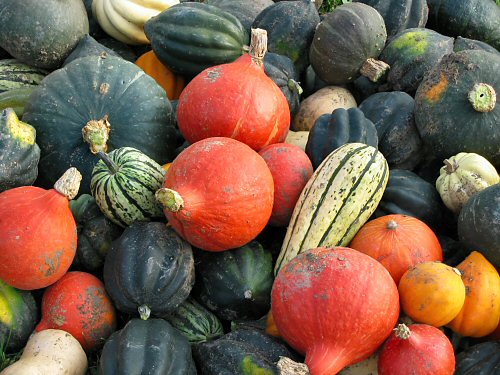
More recently, first introduced by my mother-in-law, I've been really craving the taste of winter squash. We call it pumpkin, which is typically what it's known as in Australia. There are different types of winter squash. Butternut squash is one of them. But the one that I think my mother-in-law has cooked a number of times is known as acorn squash.
Winter squash, as one would expect from its name is actually not harvested during the winter. They are picked during the fall and can store quite well at room temperature through spring. The one we have been cooking has a dark green, hard outer skin, with a dark orange flesh. Little did we know that we can also eat the skin when cooked long enough. Acorn squash can be easily found in local supermarkets. We learned that it's most ready to cook when the green skin gets more dull with little orange specks/streaks on it. Also, once you break it open, if the flesh is dark orange, you'll know it's sweet and ready to cook.
You can eat this by itself, steamed, or slow-cooked in a frying pan. Leaving the skin on adds texture. The skin can be soft enough for even baby to eat. Add a splash of chicken broth or a dash of salt to taste and it's good to go! If you want to add variety, you can cook it and then add some bite-sized pork shoulder pieces to the mix. I also noticed there's tons of recipes online for winter squash including a risotto. Mmm...yummm..
Winter squash is known for its nutritious value including beta-carotene, vitamin A, C, potassium, fiber, folate, omega-3 fatty acids, and vitamin B. It also contains iron.


No comments:
Post a Comment